


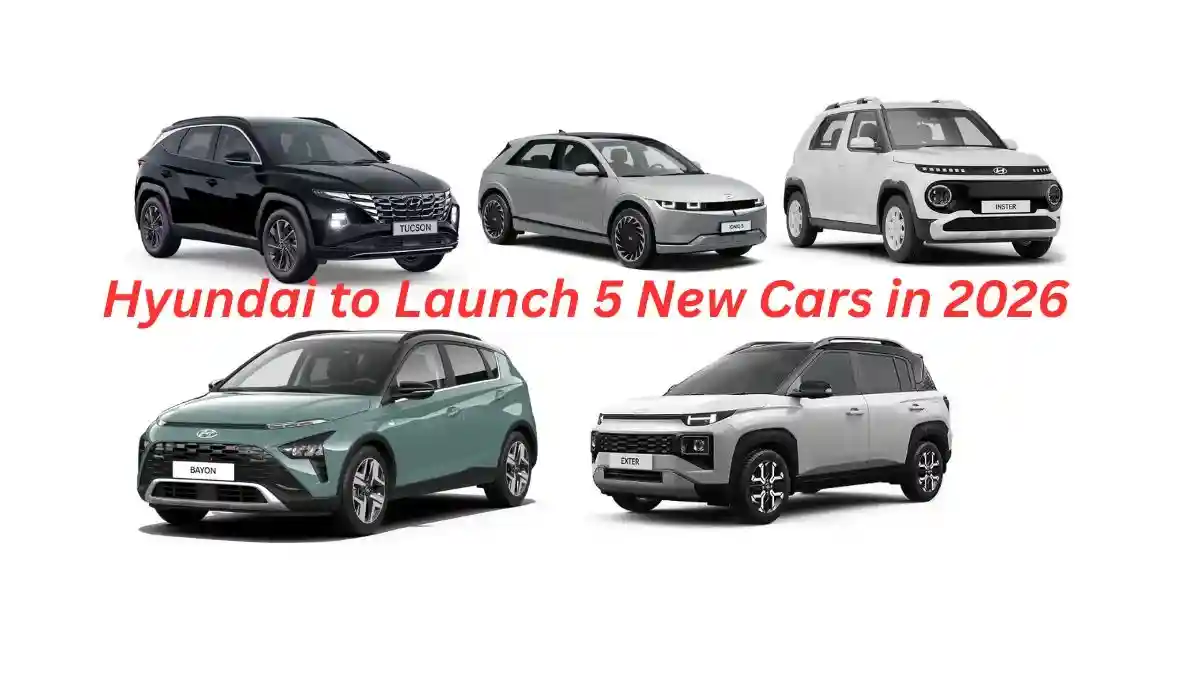
Hyundai India has a packed launch calendar for 2026. The company has already started the year strongly with the Verna Facelift and the Venue Diesel AT in March. Across the rest of 2026, Hyundai cars is planning to introduce five new models — the Exter Facelift, the all-new Bayon, the Ioniq 5 Facelift, the Inster EV, and the Tucson Facelift.
1. Hyundai Exter Facelift
Expected Launch: Mid-2026 (June 2026) Expected Price: ₹5.80 lakh to ₹10.50 lakh (ex-showroom)
The Exter facelift will carry over the same 1.2-litre Kappa naturally aspirated petrol engine. In petrol form, it produces 83 PS and 113.8 Nm of torque. It will continue to be available with a 5-speed manual and a 5-speed AMT automatic. The CNG variant producing 69 PS and 95.2 Nm will continue, and may receive an AMT option for the first time, which would make it one of the only sub-compact CNG automatics in its segment.
The H-shaped LED DRL signature at the front which has become the Exter’s trademark look is being retained. The front grille and bumpers are expected to get revised designs that make the car look sharper. The rear is expected to get a connected LED tail light bar that runs across the width of the car, a design update that will bring it in line with higher-segment Hyundai models. New alloy wheel designs are also expected.
The current Exter has an 8-inch screen. The facelift is expected to be the first Hyundai model in India to get Hyundai’s next-generation infotainment system on a larger display. A fully digital instrument cluster is also expected on higher variants. Wireless Android Auto and Apple CarPlay are expected to be standard across more variants. Ventilated front seats may be added on the top trim.
2. Hyundai Bayon
Expected Launch: Second half of 2026 (October 2026) Expected Price: ₹10 lakh to ₹15 lakh (ex-showroom)
1.2-litre turbocharged petrol engine that is being built specifically for the Indian market. This engine is expected to produce around 120 PS to 160 PS depending on the state of tune. It will be positioned between the 1.0-litre turbo and the 1.5-litre turbo in Hyundai’s engine portfolio. Transmission options are expected to include a 6-speed manual and a 7-speed DCT automatic. The 1.0-litre turbo petrol with mild hybrid technology is also a possibility. The Bayon will be a front-wheel-drive vehicle.
Bayon is expected to get dual 12.3-inch screens for infotainment and the instrument cluster the same setup as the 2026 Venue. Other expected features include a sunroof, automatic climate control, wireless charging, ventilated front seats, a Bose 8-speaker sound system on higher variants, and Hyundai’s BlueLink connected car technology. Level 2 ADAS is expected on top trims.
Ground clearance is expected to be around 183mm. Globally the Bayon measures 4,180mm in length, but Hyundai will likely shorten it to under 4 metres for India to qualify for lower GST rates.
3. Hyundai Ioniq 5 Facelift
Expected Launch: Mid-2026 (July 2026) Expected Price: ₹48 lakh to ₹53 lakh (ex-showroom)
The facelift Ioniq 5 is 20mm longer than the current model at 4,655mm. The alloy wheel design has been updated to a more EV-centric look. Flush door handles, which open automatically via touch sensors, are now fitted as standard. The rear parametric pixel LED tail lamps have been redesigned. A new colour Cactus Field has been added to the palette globally.
Inside, the steering wheel is now a three-spoke unit instead of the current two-spoke design. The wireless charging pad has been repositioned to a more accessible location. New interior colour options including Black, Grey, and Dark Green are available on the top trim. Additional convenience and connected car features have been added.
The facelift Ioniq 5 gets a larger 84 kWh battery pack, up from the current 72.6 kWh. This extends range further and improves charging capability. The motor continues with rear-wheel drive as standard, with the option of a dual-motor all-wheel-drive setup on higher variants globally though India may only get the standard RWD variant at launch. The charging speed supports ultra-fast DC charging at 350 kW, enabling a 10 to 80 percent charge in approximately 18 minutes.
4. Hyundai Inster EV
Expected Launch: June 2026 Expected Price: ₹12 lakh to ₹15 lakh (ex-showroom)
The Hyundai Inster is Hyundai’s smallest and most affordable electric vehicle globally. It was unveiled internationally in 2025 and won the 2025 World Electric Vehicle of the Year award at the World Car Awards
The Inster has a boxy, retro-inspired design with modern touches. The front features pixel LED headlamps that take design cues from the larger Ioniq 5. Inside, the Inster gets a dual 10.25-inch screen setup for the infotainment system and the instrument cluster. Other features include a single-pane sunroof, 64-colour ambient lighting, a wireless phone charger, heated steering wheel and driver’s seat, and Vehicle-to-Load (V2L) functionality.
Safety features include 6 airbags, a 360-degree camera with a blind-spot monitor, ABS with EBD, and an ADAS suite including lane keep assist, adaptive cruise control, and automatic emergency braking. However, some ADAS features may be limited on the India-spec version.
The Inster is available globally with two battery options. The standard 42 kWh battery offers a WLTP range of approximately 300 km. The larger 49 kWh battery extends WLTP range to approximately 355 km. Fast charging at 120 kW allows a 10 to 80 percent charge in approximately 30 minutes. AC charging takes around 4 to 4.5 hours on a home charger.
5. Hyundai Tucson Facelift
Expected Launch: Second half of 2026 (June to December 2026) Expected Price: ₹29 lakh to ₹36 lakh (ex-showroom)
The Tucson facelift gets a significantly redesigned exterior. Spy shots reveal a boxier stance, a flatter bonnet, vertically stacked LED headlights, cross-pattern DRLs, and a full-width LED light bar. The design takes strong inspiration from the new Santa Fe, giving it a more upright and premium road presence compared to the flowing lines of the current model. New alloy wheels with a 20-inch diameter and pop-out flush door handles are also expected.
Inside, the big change is the introduction of Hyundai’s Pleos curved display a single large curved panel that houses both the infotainment system and the digital instrument cluster. A head-up display, floating centre console, and Hyundai’s new AI assistant called Gleo for natural voice commands are all expected. Other features include ventilated and heated front seats, Boss Mode for the front passenger seat, ambient lighting, Level 2 ADAS, a 360-degree camera, and Hyundai’s BlueLink connected car suite.
The upcoming Tucson facelift is expected to focus on electrified powertrains. The petrol and diesel options from the outgoing model a 2.0-litre petrol producing 154 bhp and a 2.0-litre diesel producing 184 bhp, both paired with automatic gearboxes
Hyundai is playing smart and safe game. Instead of doing any big changes Hyundai polishing their best selling vehicles. With strong sales and good service network Hyundai is became county’s reliable car brand. After launching above mentioned cars will help Hyundai to increase their market share.