


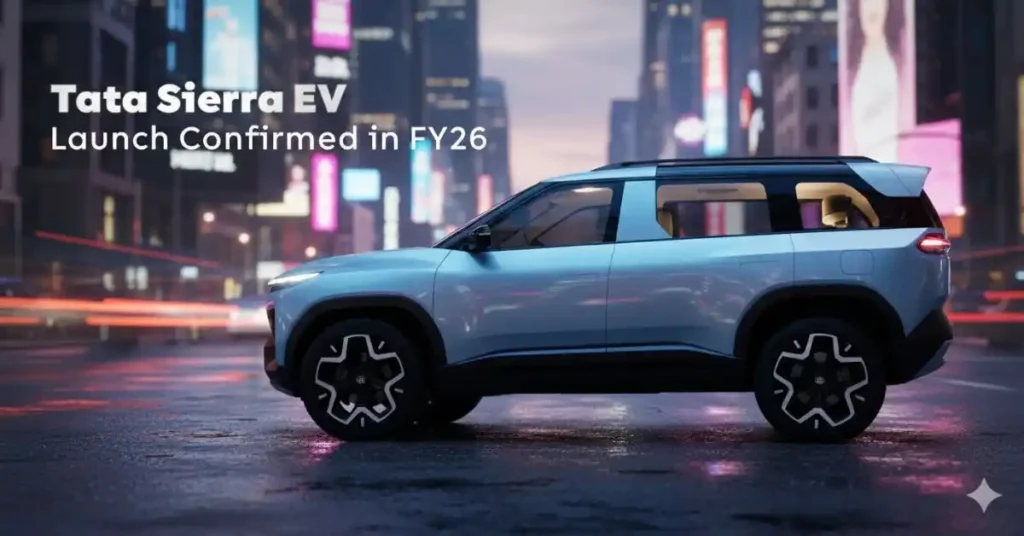
Tata Motors has officially confirmed that the Tata Sierra EV launch date is set for Q1 FY2027, placing its India debut squarely between April and June 2026. This is not a vague “sometime in 2026” hint anymore. This is a specific, committed launch window — and it means the Sierra EV is very, very close
Tata Motors has officially confirmed that the Tata Sierra EV will launch in India between April and June 2026 (Q1 FY2027). After previously indicating a 2026 debut, this is the first time the company has announced a precise launch window for the all-electric SUV.
When an automaker narrows a launch window from “sometime in 2026” to a specific quarter, it typically means production tooling is finalized, regulatory certifications are either complete or very close to completion, and the retail infrastructure — dealership readiness, test drives, initial stock — is being actively prepared.
The SUV has already been seen undergoing extensive road test evaluation as the development is entering its final stretch ahead of production. That is exactly the kind of development stage detail that gives a confirmed launch window genuine credibility.
Once launched, the Tata Sierra EV will become Tata’s seventh electric vehicle in India, further solidifying Tata Motors’ position as a leader in the country’s EV market, giving it one of the most diverse electric portfolios — even wider than some dedicated battery electric vehicle manufacturers.
Tata Sierra EV 2026 India arrives into a market that Tata itself has done more to shape than perhaps any other automaker. The Nexon EV kickstarted mass-market EV adoption. The Punch EV brought electrification to the sub-compact space. The Curvv EV introduced a sleek coupe-SUV body style. The Harrier EV brought genuine premium electric capability to the mid-size segment. The Sierra EV is the next chapter — and it may be the most emotionally resonant one yet.
Also Read:https://newstoq.com/new-gen-toyota-fortuner-spied/
The Design:
One of the most exciting things about the Tata Sierra EV design is that Tata has genuinely tried to honour what made the original Sierra iconic — without turning it into a nostalgia exercise that looks dated.
Similar to its ICE counterpart, the Tata Sierra EV will feature an upright and bold stance. However, a few EV-specific cosmetic changes will differentiate it from the ICE-powered Sierra. Upfront, the EV will sport a closed-off grille, a flat bumper with a light bar and a raised bonnet. The newly-designed aero-optimized alloy wheels, short overhangs, connected LED light bar at the rear, and wraparound glass will further enhance its EV-specific look.
That wraparound rear glass is not accidental. It is a direct and deliberate nod to the original 1991 Sierra’s most defining design feature — the massive curved rear window that gave the car its distinctive profile. Tata’s design team has reimagined it for the EV era, modernising it with clean lines and contemporary proportions while keeping its emotional core intact.
The new Tata Sierra 2026 presents itself as a proper five-door, five-seat family SUV in its production form, moving away from the original’s three-door layout. The front face, dominated by the closed-off grille typical of EVs (since there is no combustion engine requiring airflow cooling), carries slim LED signature lighting that gives it a futuristic face with enough mass and visual presence to command the road.
What makes the Tata Sierra EV design proposition interesting is that it occupies a visual space between the Curvv EV’s swoopy coupe-SUV silhouette and the Harrier EV’s large, imposing presence. It is boxy enough to feel commanding, modern enough to feel fresh, and distinctive enough that you would actually recognise it in traffic — which, in a market increasingly crowded with anonymous-looking electric crossovers, is genuinely valuable.
Expected Specifications:
Official specifications have not been released by Tata Motors. The following details are based on confirmed platform relationships, spy shot observations, and credible automotive industry reporting. All powertrain and battery figures should be treated as expected until official confirmation.
Platform: The Tata Sierra EV will utilise Tata’s Acti.ev+ skateboard platform — a dedicated EV architecture that will find its way to several upcoming electrified models. It is also set to share several components with the Tata Harrier EV. The Acti.ev+ platform is significant because it was designed specifically for electric vehicles from the ground up — not adapted from an existing petrol car’s underpinnings — which typically results in a better weight distribution, a flatter floor (more cabin space), and more flexible battery packaging.
Battery and Range: The Tata Sierra EV is likely to share its powertrain options with the Harrier EV. Currently, the Harrier EV is offered with 65kWh and 75kWh battery packs. The 65kWh variant delivers a claimed range of 538 km per charge. It produces 235 bhp and 315 Nm of peak torque. The larger 75kWh battery pack generates 390 bhp and 504 Nm of torque. If the Sierra EV adopts these battery options, it would be positioned to offer real-world ranges in the 400–480 km bracket on a full charge — genuinely usable distances for both city commuters and weekend road trippers.
Drive Configurations: Both single-motor rear-wheel-drive and dual-motor all-wheel-drive configurations are expected. An AWD Tata Sierra EV would be a first for Tata in the true sense — the Harrier EV’s dual-motor setup was the first for the brand, and the Sierra would carry that forward with genuine off-road-oriented credibility.
Charging: Fast charging capability, consistent with Tata’s current portfolio, is expected to support DC fast charging that can restore a significant portion of range in 30–45 minutes.
Compared to the Tata Harrier EV — which is the closest sibling in Tata’s own lineup — the Tata Sierra EV is expected to occupy a slightly different design-led niche while offering comparable range and powertrain performance. Against the Mahindra XUV.e8, which targets premium electric SUV buyers with a more technology-heavy pitch, the Sierra’s retro-modern design and brand storytelling give it a distinct identity that appeals to buyers who want both substance and soul.
Also Read:https://newstoq.com/2026-skoda-kushaq-facelift/
Interior and Features:
Tata is preparing a heavily digital interior environment centred around a three-screen layout — a digital driver’s display, a large infotainment unit, and a dedicated passenger-side screen. Even entry-level trims are projected to be well equipped, while higher variants may introduce Level 2 ADAS, connected car technology, powered front seats, ambient lighting, 360-degree camera, and dual-zone automatic climate control.
That three-screen interior layout is ambitious and, if executed well, would put the Sierra EV’s cabin in the conversation alongside far more expensive electric SUVs. Level 2 ADAS — which includes adaptive cruise control, lane-keeping assist, and automatic emergency braking — would be a significant functional upgrade for Tata’s lineup and a direct answer to what competitors in the segment have been offering.
Connected car technology, OTA software update capability, and multiple drive modes including dedicated EV-specific settings like Eco, City, and Sport are all anticipated based on Tata’s broader EV platform direction. A large panoramic sunroof, which the current Sierra ICE already offers, is expected to carry over to the EV as well.
Expected Price in India:
The Tata Sierra EV expected price has not been officially announced. The following figures are based on segment positioning, platform cost benchmarks, and analyst expectations. Treat these as educated estimates only.
The upcoming Tata electric SUV in India is expected to be priced northwards of ₹19 lakh (ex-showroom), positioning it above the Tata Curvv EV. CarWale similarly projects a range of approximately ₹20–25 lakh for the Sierra EV lineup.
A realistic price band based on current comparable EV pricing in India would look something like this. The base single-motor variant is likely to open around ₹20–22 lakh (ex-showroom). Mid-spec variants with larger battery packs could sit in the ₹24–27 lakh range. The fully loaded dual-motor AWD top-spec could touch ₹30 lakh or slightly above.
This positioning would keep the Tata Sierra EV meaningfully below the Mahindra XUV.e8’s upper trims while offering more premium street presence than the Curvv EV. It is a smart gap to occupy in the Tata electric SUV 2026 lineup — premium enough to feel aspirational, but accessible enough to bring in buyers who stretched for a Harrier ICE and are now considering going electric.