


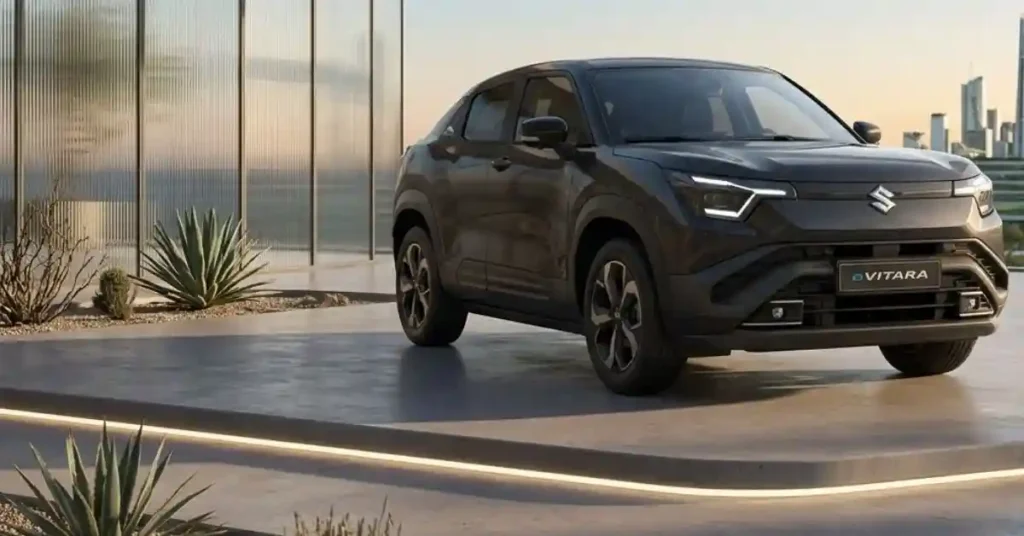
The Maruti Suzuki e Vitara launched in India in February 2026, marking one of the most anticipated debuts in the country’s automotive history. For millions of Indian car buyers who were waiting for a reliable, well-priced electric SUV from a brand they trust, this moment has been a long time coming. And based on everything Maruti has put together here, the wait may well have been worth it.
For years, Maruti Suzuki sat on the sidelines as Tata Motors, MG, and Hyundai carved out the Indian EV market. Critics questioned the delay. But Maruti’s leadership had a clear strategy: wait for the right moment, get the product right, and then use the brand’s unmatched sales and service network to scale fast.
The e Vitara is the result of that approach. Built on Suzuki’s dedicated HEARTECT-e electric platform and jointly developed with Toyota, this SUV is Maruti’s first fully electric product for both the Indian and global markets. It is sold exclusively through NEXA showrooms, which gives it a premium positioning while still targeting the mainstream buyer.
What makes this launch truly significant is the scale of trust Maruti brings to the table. With over 4,000 service centres across the country, first-time EV buyers no longer have to worry about where to get their car serviced after a breakdown. That peace of mind is something competitors simply cannot match right now.
Also Read:https://newstoq.com/next-gen-renault-duster-india/
Maruti Suzuki e Vitara Price in India
The Maruti EV price is structured across three variants, giving buyers a clear choice based on their budget and requirement.
The Delta (49 kWh) starts at ₹15.99 lakh, the Zeta (61 kWh) is priced at ₹17.49 lakh, and the fully loaded Alpha (61 kWh) tops out at ₹19.79 lakh — all prices ex-showroom. A dual-tone version of the Alpha goes slightly higher to approximately ₹20.01–₹20.94 lakh depending on the variant combination.
These prices position the e Vitara launch India right in the thick of the competitive mid-size electric SUV segment, going head-to-head with the Tata Nexon EV, Hyundai Creta Electric, and MG ZS EV.
What Is the BaaS Model and How It Works?
BaaS Model stands for Battery-as-a-Service, and it is arguably the most innovative financial product seen in the Indian auto space in years.
Think of it this way: the battery is the most expensive component in any electric car, often accounting for 30–40% of the total vehicle cost. The BaaS model removes the battery from the upfront purchase price entirely. You buy the car, and you pay for the battery separately based on how much you actually drive.
Under Maruti’s BaaS Model scheme, the e Vitara’s entry price drops to just ₹10.99 lakh (introductory, ex-showroom) — a price that puts it squarely in the territory of a well-equipped petrol SUV. In addition to this, you pay a battery usage fee of ₹3.99 per kilometre for the 49 kWh model.
If you drive 60 kilometres a day — a fairly typical urban commute — your daily battery cost works out to roughly ₹239. Monthly, that’s around ₹7,200. For many urban buyers, this is comparable to monthly petrol expenses, making the switch to electric more financially transparent and predictable.
The BaaS model for the Zeta and Alpha variants (both 61 kWh) is priced at ₹11.99 lakh and ₹14.29 lakh respectively under the scheme, with a usage charge of ₹4.39 per kilometre.
This introductory BaaS Model offer is valid until 31 March 2026, so buyers looking to maximise the benefit need to act soon.
Maruti is also offering an ‘e-Flex’ scheme for existing car owners — a plan designed to let you upgrade to the e Vitara with an EMI similar to what you’re already paying on your current vehicle. That kind of financial engineering makes a lot of sense for India’s upgrade market.
Battery, Range, and Performance
The e Vitara comes with two battery pack options. The 49 kWh version delivers a claimed range of 440 km on a single charge, while the 61 kWh variant pushes that up to an impressive 543 km — a figure that comfortably handles even the most range-anxious buyer’s concerns.
Both variants are powered by a single front-mounted electric motor producing 142 bhp and 193 Nm of torque, driving the front wheels. There is no AWD option for India, which is a minor trade-off worth noting.
On the charging front, the e Vitara supports DC fast charging that takes the battery from 10% to 80% in just 45 minutes. The bundled 7.4 kW AC wall box charger can take it from 10% to 100% in about 6.5 hours — perfectly suited for overnight charging at home.
Maruti has also established a network of over 2,000 charging stations across 1,100 cities, accessible through the ‘e for me’ app, which integrates 13 different charge point operators in one place. The ambition is to scale this to 1,00,000 stations by 2030.
Features and Technology
The e-Vitara doesn’t hold back on the features front. Across variants, you get dual 10-inch screens (an infotainment display and a digital instrument cluster), wireless phone charging, a fixed glass sunroof, ventilated front seats, a 360-degree camera, and automatic climate control.
The top Alpha variant also adds a 10-way power-adjustable driver’s seat, an Infinity audio system, and auto-dimming IRVM.
On the safety side, every variant comes with 7 airbags as standard — including a driver-side knee airbag — along with Level 2 ADAS features like Adaptive Cruise Control, Lane Keep Assist, Automatic Emergency Braking, and Blind Spot Monitoring.
The e-Vitara has already earned a 5-star Bharat NCAP safety rating, making it the first electric SUV in India to do so under the updated Bharat NCAP protocol. It also secured a 4-star Euro NCAP rating. For safety-conscious Indian families, this is a significant reassurance.
Next-Gen Suzuki Connect brings over 60 connected car features, including remote monitoring, vehicle tracking, and over-the-air updates.
Comparison with Rivals
The Maruti electric car 2026 enters a market that already has established players, and the competition is serious.
The Tata Nexon EV remains the segment benchmark — proven, trusted, and available in a wide range from ₹12.49 lakh to ₹19.49 lakh. It has the advantage of Tata’s established EV ecosystem. However, the e-Vitara counters with a longer top-end range (543 km vs up to 465 km for Nexon EV), better ADAS features, and Maruti’s service network advantage.
The Hyundai Creta Electric is priced between ₹17.99 lakh and ₹23.50 lakh — a notch above the e-Vitara in price. It offers AWD in the top variant and a premium feel, but the e-Vitara undercuts it on price while offering comparable range.
The MG ZS EV is an older product now, priced from around ₹18.98 lakh, and it faces stronger competition from newer entrants. The MG Windsor EV is a closer rival on the BaaS front, with BaaS pricing starting at ₹9.99 lakh, though it doesn’t carry the Maruti trust factor or service depth.
For more details:https://www.carwale.com/maruti-suzuki-cars/e-vitara/
Pros and Cons
Pros:
- Strong claimed range of up to 543 km
- Maruti’s unmatched service network across India
- Innovative BaaS model lowers entry price significantly
- 5-star Bharat NCAP safety rating
- Level 2 ADAS and 7 airbags as standard
- Comprehensive NEXA Edge ownership package with free home charger
Cons:
- No AWD option available in India
- BaaS introductory offer is time-limited (till March 31, 2026)
- Rear seat legroom and underthigh support could be better
- Boot space is on the smaller side compared to some rivals