


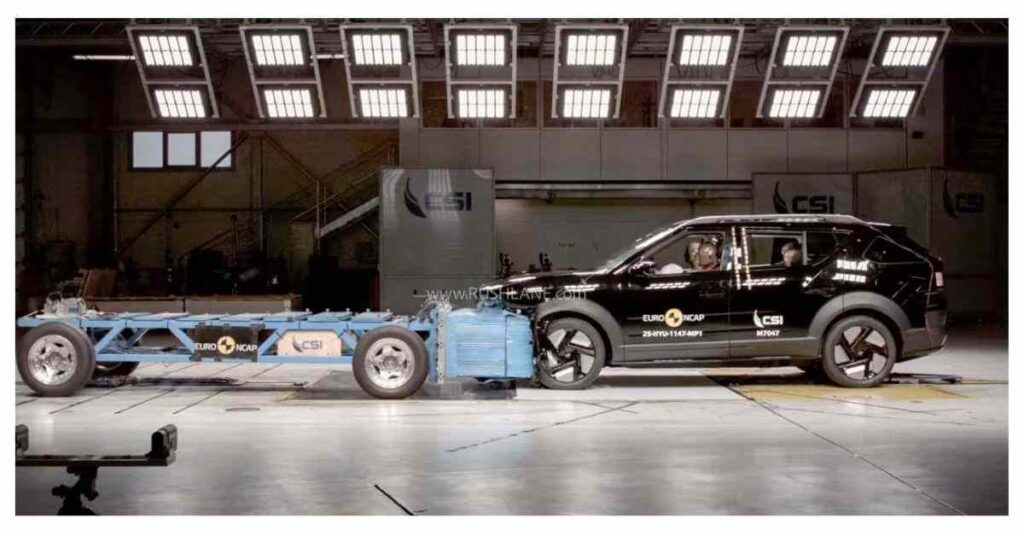
The European New Car Assessment Programme (Euro NCAP) put the Hyundai Nexo FCEV through its brutal gauntlet of crash tests, and the results were historic. The Nexo didn’t just pass; it secured a flawless five-star safety rating, becoming the first fuel-cell electric vehicle to ever achieve the top score.
The Hyundai Nexo FCEV achieved its five-star Euro NCAP rating by proving that hydrogen tanks are just as safe—if not safer—than traditional gasoline tanks or heavy lithium-ion batteries.
The Scoring Breakdown
Euro NCAP evaluates vehicles across four key pillars. The Nexo’s performance was remarkably balanced:
| Assessment Area | Score Percentage | Expert Take |
| Adult Occupant Protection | 94% | Exceptional structural integrity in offset and side impacts. |
| Child Occupant Protection | 87% | High scores for both 6 and 10-year-old dummy protection. |
| Vulnerable Road Users | 67% | Solid performance in pedestrian detection and “Auto Emergency Braking.” |
| Safety Assist | 80% | Comprehensive suite of AI-driven driver aids as standard. |
Also Read:https://newstoq.com/2026-mg-hector-facelift-launched-in-india/
By hitting these marks, Hyundai silenced the skeptics who feared that high-pressure hydrogen storage was a safety liability. The Nexo proved that with the right engineering, hydrogen is a viable, safe alternative for families (Source: Euro NCAP).
The biggest question on everyone’s mind during the Hyundai Nexo FCEV crash tests was: What happens to the hydrogen? The Triple-Layer Protection Hyundai didn’t just put gas in a tank; they built a vault. The Nexo features three identical high-pressure tanks located under the rear seats and trunk. These tanks are constructed with:
-
An inner liner of high-strength polymer to prevent leaks.
-
A thick carbon-fiber layer to handle pressures up to 700 bar (roughly 10,000 psi).
-
An outer glass-fiber layer to protect against road debris and impact (Source: Hyundai Motor Group Tech).
During the Euro NCAP side-impact and rear-collision tests, sensors monitored the tanks for any drop in pressure. In a severe accident, the system is designed to automatically shut off the supply of hydrogen. If the car detects fire, it utilizes a directional thermal pressure relief device to vent the gas safely upward and away from the cabin, preventing a pressure buildup.
Also Read:https://newstoq.com/skoda-auto-achieved-5-lakh-cumulative-sales-in-india/
The Hyundai Nexo FCEV isn’t just a rolling chemistry set; it’s a masterpiece of structural engineering. In the “Adult Occupant” test, the Nexo scored a massive 94%.
Euro NCAP testers noted that the passenger compartment remained stable during the frontal offset test. Protection for the knees and femurs of both the driver and passenger was “good,” regardless of the occupant’s size or seating position.
In the side-barrier test—simulating a broadside collision—the Hyundai Nexo FCEV scored maximum points, protecting all critical body areas. This is largely due to the extensive use of Advanced High-Strength Steel (AHSS) in the frame, which disperses energy around the cabin rather than through it (Source: Euro NCAP).
For child protection, the Hyundai Nexo FCEV earned an 87% score. The SUV is equipped with ISOFIX and i-Size anchor points that kept the 6 and 10-year-old dummies secure during both frontal and side impacts. Hyundai’s “Rear Occupant Alert” also adds a layer of safety, reminding parents if a child is left in the back seat.
A five-star rating in the modern era requires more than just a strong frame; it requires “active” safety. The Hyundai Nexo FCEV comes standard with Hyundai SmartSense, a suite of Advanced Driver Assistance Systems (ADAS).
Key Active Safety Features:
-
Forward Collision-Avoidance Assist (FCA): In Euro NCAP testing, this system successfully avoided collisions with other vehicles at most test speeds.
-
Lane Keeping Assist (LKA): The Nexo prevents unintentional lane drifting by gently steering the car back to the center.
-
Blind-Spot View Monitor (BVM): A segment-leading feature that shows a live video feed of the blind spot in the digital cluster when the turn signal is activated.
-
Remote Smart Parking Assist (RSPA): This allows the Nexo to park itself autonomously, even if the driver is standing outside the vehicle—perfect for tight European parking spots (Source: Autocar India).
The only area where the Nexo saw a slight dip (67%) was in “Vulnerable Road User” protection. This is a common trend among SUVs due to their high front profiles.
However, the Nexo’s Active Hood System is a standout feature. When sensors detect a collision with a pedestrian, the hood lifts slightly to create a cushion between the person and the hard engine components underneath. The Autonomous Emergency Braking (AEB) system also performed well in detecting cyclists and pedestrians during daylight hours, preventing several simulated accidents (Source: Euro NCAP).
The Hyundai Nexo FCEV achieving five stars in Euro NCAP is a watershed moment for the automotive industry. It proves that we don’t have to sacrifice safety for sustainability.