


The revolution of electric vehicles in India (EV) has long faced one enormous, silent speed bump: range anxiety. It is the nagging fear that your battery will die on a desolate highway, leaving you stranded. India’s largest and most trusted automaker, Maruti Suzuki, recognized this fundamental psychological barrier. Now, they are not just launching an EV; they are building the entire highway system underneath it.
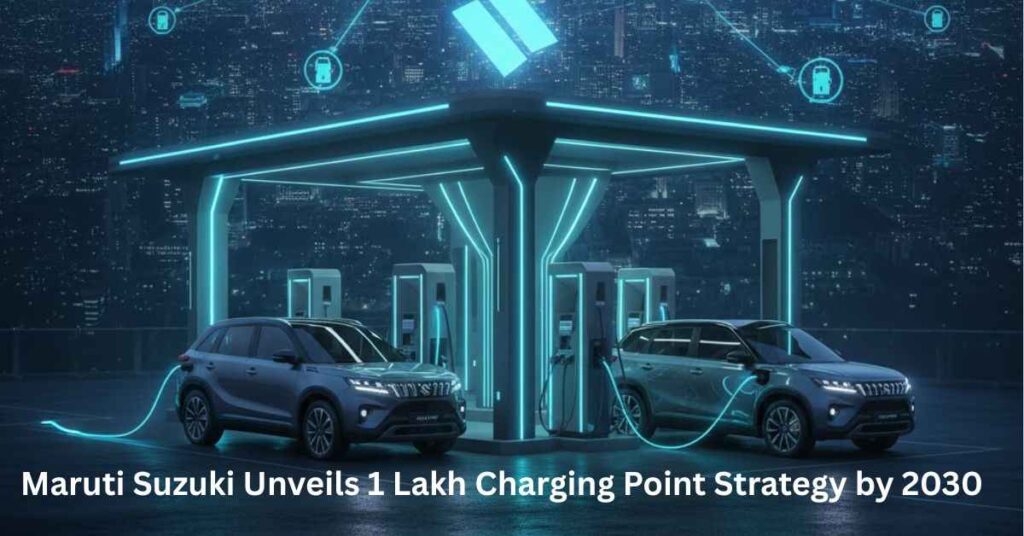
On December 2, 2025, Maruti Suzuki India Limited (MSIL) made a historic announcement that fundamentally shifts the landscape for electric vehicles in India. They unveiled a massive, unified EV charging ecosystem, setting an audacious goal: enabling over 1,00,000 public charging points by 2030. This isn’t just a promise; it’s a strategic move designed to leverage the company’s unparalleled market reach, finally giving the Indian consumer the “peace of mind” required for mass EV adoption (Source: Maruti Suzuki Press Release, December 2, 2025).
This expert deep-dive dissects the intricate details of Maruti Suzuki’s “One India, One EV Charging” platform, known as ‘e for me’, revealing how the company plans to overcome the infrastructure deficit and solidify its position as a leader in the future of electric vehicles in India.
The Core Strategy: Unified Access and Massive Scale
Maruti Suzuki’s approach to the EV segment is a classic example of logic dictating strategy. Since they are a later entrant to the EV vehicle race compared to Tata Motors, they recognized that they cannot just compete on cars; they must compete on the ecosystem.
A. The Power of Partnership: 13 CPOs and Aggregators
Achieving the 1 lakh charging point target by 2030 requires scale and speed that no single entity can manage alone. Maruti Suzuki is not attempting to build 100,000 chargers from scratch; they are unifying existing and future networks.
The Collaboration: The company signed agreements for electric vehicles in India with 13 leading Charge Point Operators (CPOs) and aggregators, including major players like IOCL, Tata Power, Jio BP Pulse, Chargezone, Adani Total Energies E-mobility, and Statiq (Source: ACKO Drive, December 2, 2025).
The Unification: This unprecedented set of partnerships means Maruti Suzuki EV owners gain access to a vast, pan-India network immediately. This is the crucial difference the network is integrated, reducing the user’s need to juggle multiple apps and payment methods.
B. The Digital Linchpin: The ‘e for me’ Platform
The entire 1 lakh charging point ecosystem for electric vehicles in India is anchored by the ‘e for me’ digital platform. This mobile application is the definitive answer to the user experience problem in public charging.
End-to-End Solution: The app is designed to manage all EV charging needs: finding chargers, initiating the charging session, and making unified payments (via UPI or ‘Maruti Suzuki Money’).
Seamless Integration: The app’s map and functionality are mirrored on the infotainment system of Maruti Suzuki’s upcoming EVs, such as the e-Vitara, allowing for in-car charger discovery and route planning.
Proactive Information: The app is available to the public even before they own an e-Vitara, allowing prospective customers to view the massive national charging map, directly addressing range anxiety before the purchase decision is even made (Source: India Today, December 3, 2025).
Maruti Suzuki is adopting a dual approach to network expansion: leveraging its current strength and strategically deploying new capacity where it matters most for electric vehicles in India.
A. Dealer Network Strength (Immediate Access)
Maruti Suzuki possesses India’s largest sales and service network, a foundation that rivals cannot match. They immediately converted this asset into an EV advantage.
Exclusive Charging Points: The company has already established over 2,000 exclusive Maruti Suzuki charging points across its dealer network, spanning more than 1,100 cities (Source: Maruti Suzuki Press Release).
Service Readiness: Complementing this, Maruti Suzuki has activated 1,500+ EV-ready service workshops across the same 1,100 cities, staffed by a massive 1.5 lakh-strong, specially-trained EV workforce (Source: DriveSpark, December 9, 2025). This ensures that service support is available even in remote corners of the country.
B. Strategic Deployment (Future Growth)
The ambitious 1 lakh goal focuses on closing two major connectivity gaps: urban density and inter-city highways.
| Charging Zone | Deployment Strategy & Target | Rationale for EV Adoption |
| Top 100 Cities | Chargers at an average distance of 5–10 kilometres in key locations (malls, commercial hubs). | Reduces urban anxiety; makes daily city commutes hassle-free and predictable. |
| Major Highways | DC Fast Chargers located at regular intervals along key highways (e.g., Srinagar to Kanyakumari, Bhuj to Dibrugarh). | Enables nationwide driving freedom and long-distance travel feasibility for electric vehicles in India. |
| Rural & Tier-2/3 | Leveraging CPO partners and the widespread dealer network to provide charging in unserved areas. | Extends electric vehicles in India feasibility beyond metros, catering to Maruti’s traditional customer base. |
This strategy ensures that the infrastructure development is practical, focusing heavily on convenience to normalize EV usage in dense urban areas and enabling long-distance road trips with fast-charging options.
The Logic Behind the Target: Overcoming the EV Barrier
Why set the target at exactly 1,00,000 charging points by 2030? This number is not random; it reflects a calculated effort to fundamentally alter consumer perception of electric vehicles in India.
A. The Range Anxiety Destroyer
Industry studies consistently cite the lack of adequate charging infrastructure as the single biggest bottleneck to faster EV adoption. While India currently has around 30,000 public EV charging stations, this number is severely inadequate for a nation of this scale (Source: Financial Express, December 3, 2025).
Maruti Suzuki’s 1 lakh target creates a psychological tipping point. It sends a clear message that their EVs—beginning with the e-Vitara will be supported by a density of charging options that makes running out of battery an extremely rare event.
B. A Commitment to the EV Line-up
This infrastructure commitment is directly tied to Maruti Suzuki’s product roadmap. The company intends to launch multiple electric vehicles in India across various body types and segments by 2030, aligning with Suzuki’s global vision (Source: BioEnergy Times, December 3, 2025).
You can’t sell millions of small, efficient electric vehicles in India without a nationwide grid to support them. By building the charging ecosystem first, Maruti ensures every new EV model they launch is immediately practical for 90% of the driving population. They are using infrastructure readiness to mitigate the risk of being a late entrant to the market.
C. The ₹250 Crore Investment & Financial Proof
To demonstrate the seriousness of the initiative, Maruti Suzuki confirmed an investment of ₹250 crore specifically towards developing this charging infrastructure for electric vehicles in India through its dealer network and the creation of the ‘e for me’ app (Source: NDTV Profit, December 2, 2025). This capital commitment is a tangible fact that adds immense credibility to the 1 lakh target, confirming the plan is not merely aspirational but financially backed.
More Than Just Charging: The Ecosystem Philosophy
Maruti Suzuki’s strategy goes beyond just plugging in. They are constructing an entire EV ownership framework designed to eliminate any reason for a customer to hesitate.
Vehicle Excellence: The company’s first EV, the e-Vitara, has been rigorously tested across extreme climates (from -30°C to +60°C) and achieved a 5-star Bharat NCAP safety rating, becoming the first EV SUV in India to do so (Source: NamasteCar, December 5, 2025). A great car needs great support.
Flexible Ownership: The company is introducing innovative ownership models, including Battery-as-a-Service (BaaS) and assured buyback programs. BaaS, where the customer rents the battery monthly, significantly reduces the upfront cost of the EV, making it immediately accessible to a wider market (Source: Financial Express).
By addressing the three primary customer pain points Range Anxiety (1 lakh chargers), High Price (BaaS), and Service Worry (1.5 lakh trained staff)—Maruti Suzuki is strategically positioning itself for market leadership. The 1 lakh charging points for electric vehicles in India are the physical manifestation of this confidence. They are building the robust, seamless infrastructure that will finally transform the dream of widespread electric vehicles in India into a sustainable, comfortable reality.