


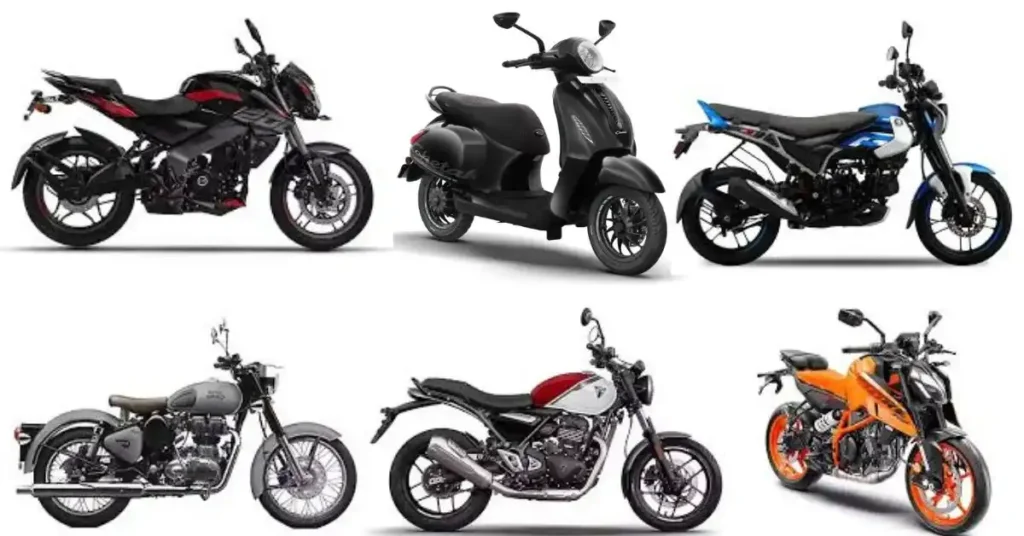
Bajaj Auto, the Pune-based giant, In a recent strategic reveal, the company confirmed eight new motorcycles and scooters are scheduled to hit the streets by mid-2026.
1. The All-New Bajaj Pulsar 125
Bajaj Auto will launch a completely redesigned Pulsar 125. Sources indicate it will move to the modern Pulsar N-platform. Expect a sharper, “shrunken N250” aesthetic with a more muscular tank and a sleek LED headlamp. 125cc buyers today want the “big bike” look without the “big bike” fuel bills.
Mechanically, the engine will likely be a refined version of the current 124.45cc mill but tuned for better low-end grunt and improved heat management. We expect features like a digital console with Bluetooth connectivity as standard—a must-have for the Gen-Z buyer. This bike will be the gateway to the Pulsar “Life,” aimed squarely at reclaiming the 20% market share in the premium commuter segment.
2. The Next-Gen Bajaj Chetak
The Chetak has successfully transitioned from “humara Bajaj” to “electric Bajaj,” but it has lacked the “oomph” to take on the likes of Ather or Ola’s performance modes. By mid-2026, Bajaj Auto will launch a next-generation Chetak.
This new variant is expected to ditch the current hub motor for a more powerful mid-drive motor setup. This move allows for better weight distribution and higher top speeds (likely touching 90–95 km/h). Bajaj Auto is also working on a larger 3.5 kWh to 4.0 kWh battery pack to offer a “True Range” of over 130 km.
The design will likely remain “Neo-Retro,” but expect more aggressive color palettes and a fully digital TFT touchscreen. Bajaj Auto is betting on the Chetak’s metal body and reliability to win over customers who are tired of plastic-bodied EVs that feel like toys.
Also Read:https://newstoq.com/top-10-cars-in-india-january-2026/
3. Bajaj Freedom 150 (The CNG Expansion)
The world’s first CNG bike, the Freedom 125, was a “moonshot” that actually landed. It proved that Indians prioritize running costs above almost everything else. Building on that success, Bajaj Auto is readying a 150cc CNG motorcycle by mid-2026.
While the 125cc is great for the city, it struggles on the highway with a pillion. A 150cc CNG variant will provide that much-needed torque for small-town commutes and uphill climbs.
A 150cc engine needs a slightly larger 2kg CNG cylinder to maintain range. Expect this bike to look more like a “rugged commuter” with a slightly larger auxiliary petrol tank (likely 3 litres) to reduce “range anxiety.” If Bajaj prices this under ₹1.25 lakh, it could single-handedly disrupt the entry-level 150cc segment.
4. The Bajaj Pulsar NS350
After the launch of the NS400Z, Bajaj realized that the 400cc+ segment attracts higher taxes. To counter this, they are developing the Pulsar NS350. By keeping the displacement just under 350cc, Bajaj Auto can take advantage of the lower 18% GST bracket (compared to the 28% for larger bikes). This will allow them to price a high-performance, liquid-cooled naked bike at a price that makes rivals sweat.
The NS350 will likely borrow the chassis and suspension from the NS400Z but feature a downsized version of the 373cc engine. It will still be a “power-to-weight” champion, offering roughly 32-35 PS of power. For the rider, this means 90% of the NS400Z’s fun at 80% of the price.
Also Read:https://newstoq.com/ktm-390-adventure-r-launched/
5. A Brand New “Sub-Pulsar” 125cc Brand
During recent investor calls, Bajaj’s leadership hinted at a “missing piece” in their portfolio. While Pulsar is the “sporty” choice and Platina is the “economical” choice, there is a gap for a premium-commuter brand that is neither.
This new sub-brand (rumored to be a revival of a classic name or an entirely new identity) will target the “sophisticated commuter.” Think of it as Bajaj’s answer to the Honda Shine or the TVS Raider.
Expect a focus on refinement, sleek design, and “Segment First” features like a large under-seat storage or integrated navigation. Bajaj Auto wants to offer a 125cc bike that feels “premium” without the aggressive “boy-racer” image of the Pulsar.
Also Read:https://echodesknews.blogspot.com/2026/01/ather-450x-ota-update-infinite-cruise.html
6. The KTM 350 Duke
The partnership with KTM has been Bajaj’s ticket to global dominance. By 2026, we expect an India-specific KTM 350 Duke. Much like the Pulsar NS350, this bike is a response to India’s unique tax structure.
While Europe gets the fire-breathing 390 Duke, India will likely see a 350cc variant that retains the premium “Ready to Race” DNA. It will feature the same Adjustable WP Apex suspension and the sophisticated electronics suite (traction control, cornering ABS) but with a slightly smaller bore.
It allows Bajaj Auto to keep the price competitive against the Triumph Speed 400 and the Royal Enfield Guerrilla 450 while maintaining the premium performance KTM is known for.
7. Triumph “Speed 350”
Triumph and Bajaj have already seen massive success with the 400 series. However, to truly take on the Royal Enfield Classic 350, they need a high-volume, lower-priced entry point. Enter the Triumph Speed 350.
This bike will likely use a simpler, air-and-oil-cooled engine instead of the liquid-cooled unit in the Speed 400. The goal here is character and “thump.” It will be lighter, easier to manage, and focus on mid-range torque rather than top-end speed.
The design will stay true to the British heritage—chrome accents, a teardrop tank, and a relaxed riding posture. By launching a 350cc Triumph, Bajaj opens the door for buyers who find the Speed 400 “too fast” or too expensive, providing a direct alternative to the 350cc dominance of Royal Enfield.
8. The Pulsar “Classic” 250
To round out the eight, Bajaj Auto is working on a Pulsar 250 with a “Classic” twist. While the N250 and F250 are modern streetfighters, there is a growing demand for “Modern Retro” bikes that are easy to maintain and comfortable for long-distance riding.
This model will likely feature a round LED headlamp, a flatter seat, and perhaps even optional spoke wheels for that old-school vibe. It will use the refined 249cc oil-cooled engine, known for its incredible “tractability” (the ability to pull from low speeds in high gears).
By mid-2026, Bajaj Auto’s showroom will look vastly different. By covering every base—from CNG sustainability and Electric innovation to GST-optimized performance—Bajaj is ensuring that no matter what the Indian buyer wants, they have an answer.