
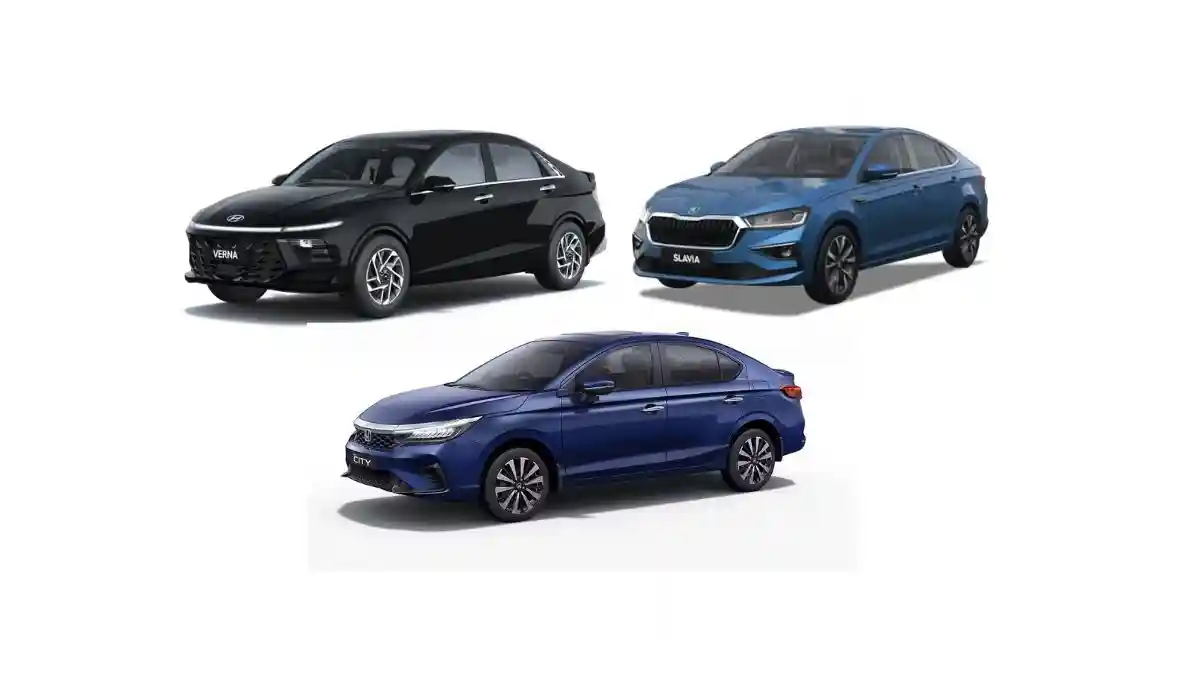
2026 Hyundai Verna Facelift launched on March 9, 2026, starting at ₹10.98 lakh (ex-showroom). It comes with over 25 upgrades including Level 2 ADAS, seven airbags as standard, a built-in dashcam, a Bose 8-speaker system, and a first-in-segment front passenger electric walk-in seat. This puts the Verna back at the front of the mid-size sedan race in India.
But the Honda City and the Skoda Slavia are still strong options in this segment. Both have loyal buyers, and both are expected to get their own updates later in 2026. So if you are buying a sedan right now, which one should you choose?
The 2026 Verna Facelift gets a revised front end with a black chrome radiator grille, dual LED projector headlamps, and a full-width LED light bar. At the rear, the connected L-shaped LED tail lights are flanked by a revised bumper with a silver insert. It is available in new colours including Classy Blue and Titan Grey Matte. At 4,565mm in length and 1,765mm in width, the Verna is the widest and longest sedan in this comparison, with the longest wheelbase at 2,670mm.
The Honda City has a nine-array LED headlamp setup with a sporty chrome-trimmed grille and Z-shaped LED tail lights. It looks clean and familiar, though the design has not changed significantly since the 2023 facelift. At 4,583mm in length, it is slightly longer than the Verna but narrower at 1,748mm. A second City facelift is expected in late 2026, so the current model is nearing the end of its update cycle.
Also Read:https://newstoq.com/next-gen-renault-duster-vs-skoda-kushaq-facelift-2026/
The Skoda Slavia has a composed sedan design with sharp lines, a flowing roofline, and wraparound tail lights. The facelift is expected around Q3–Q4 2026 with connected LED tail lights, a revised grille with lighting elements, and new alloy wheels. The current Slavia is 4,541mm long with a 2,651mm wheelbase. Once the facelift arrives, it will look considerably fresher than what is on sale now.
The 2026 Verna Facelift offers two engine options. The 1.5-litre naturally aspirated petrol produces 115 PS @ 6300 r/min and 143.8 Nm @ 4 500 r/min and is available with a 6-speed manual or IVT automatic. The 1.5-litre turbo GDi petrol produces 160 PS @ 5500 rpm and 253 Nm @ 1500-3 500 rpm, paired with a 7-speed DCT, making it the most powerful engine in this segment. Idle Stop and Go is standard on both engines.
The Honda City uses a single 1.5-litre naturally aspirated petrol engine producing 121 PS @ 6600 rpm and 145 Nm @ 4300 rpm, paired with either a 6-speed manual or CVT automatic. There is also a strong hybrid option producing 126 PS total, with claimed mileage of 27.26 kmpl — the most fuel-efficient option in this comparison. Honda does not offer a turbo petrol option on the current City.
Also Read:https://newstoq.com/2026-maruti-brezza-facelift/
The Skoda Slavia offers two turbo petrol engines. The 1.0-litre TSI produces 114 PS @ 5000-5500 rpm and 178 Nm @ 1750-4500 rpm, available with a 6-speed manual or 6-speed automatic. The 1.5-litre TSI produces 150 PS @ 5000-6000 rpm and 250 Nm @ 1600-3500 rpm with a 7-speed DSG. The current Slavia does not have a naturally aspirated option. The facelift is expected to replace the 6-speed automatic with a new 8-speed torque converter, similar to the Kushaq facelift.
The 2026 Verna Facelift leads on features in this comparison. It gets a 10.25-inch infotainment screen with wireless Android Auto and Apple CarPlay, a 10.25-inch digital cluster, Bose 8-speaker sound system, 8-way powered driver seat with memory, ventilated front seats, front passenger electric walk-in device, built-in dashcam, surround view monitor, wireless charging, dual-zone climate control, ambient lighting, and a panoramic sunroof on higher variants.
The Honda City gets an 8-inch touchscreen with wireless Android Auto and Apple CarPlay, a 7-inch part-digital instrument cluster, automatic climate control, an electric sunroof, wireless charging, leather upholstery, and ambient lighting. The feature list is solid but not as deep as the Verna on premium additions. No Bose sound system, no ventilated seats, and no surround view monitor on the City.
The Skoda Slavia gets a 10-inch touchscreen with wireless Android Auto and Apple CarPlay, a Virtual Cockpit digital cluster, automatic climate control, an electric sunroof, ambient lighting, leatherette seats, and connected car features via the MySkoda app. The interior feels premium and well-built. The facelift is expected to add a 10.25-inch digital cluster, a panoramic sunroof on top trims, and possibly ADAS.
The 2026 Verna Facelift is the strongest on paper. It gets 7 airbags as standard, Level 2 ADAS, a built-in dashcam, 360-degree camera, front and rear parking sensors, TPMS, ABS with EBD, ESC, and Hill Start Assist. The total safety feature count exceeds 75.
The Honda City gets 6 airbags, Honda Sensing ADAS (available on higher variants), collision mitigation braking, lane keeping assist, adaptive cruise control, ABS with EBD, vehicle stability assist, and a five-star ASEAN NCAP rating. Safety is strong, but ADAS is not available on base variants.
The Skoda Slavia gets 6 airbags as standard, ABS, ESC, traction control, hill hold, and a five-star Global NCAP safety rating. ADAS is not currently available on the Slavia. The facelift is expected to add ADAS on higher trims when it launches later in 2026.
The 2026 Verna is available in six variants — HX2, HX4, HX6, HX6+, HX8, and HX10.
If your budget is under ₹13 lakh: The HX2 at ₹10.98 lakh is the starting point. It gets seven airbags, Level 2 ADAS, ABS, ESC, and basic comfort features. It is the most affordable way to get ADAS and seven airbags in this segment. However, it misses the sunroof, digital cluster, and wireless connectivity.
If your budget is ₹13 lakh to ₹15 lakh: The HX4 at ₹12.25 lakh or HX6 at ₹14.40 lakh are the best choices. The HX6 adds the larger infotainment screen, digital cluster, wireless CarPlay and Android Auto, automatic climate control, and the surround view monitor. This is the variant that gives you the best balance of features and price.
If your budget is ₹15 lakh to ₹17 lakh: The HX6+ at ₹15.02 lakh adds ventilated front seats, the Bose sound system, and the dashcam. For buyers who spend a lot of time in the car — whether commuting or on long drives — this variant is worth the extra money over the HX6.
If you want the best the Verna offers and have a ₹18 lakh+ budget: The HX8 at ₹16.09 lakh and HX10 at ₹18.25 lakh get the 160 PS turbo engine, 7-speed DCT, paddle shifters, and all the top features. The HX8 is the turbo manual and the HX10 is the turbo DCT. If you want performance with automatic convenience, the HX10 is the one to go for.
2 thoughts on “2026 Hyundai Verna Facelift vs Honda City vs Skoda Slavia — Which Sedan Should You Buy?”